a template for a course: toward an anti-racist architecture [2020]
[PIDGIN 28 | READ THE ARTICLE HERE]
Pidgin is a publication edited and designed by graduate students at the Princeton University School of Architecture. The name Pidgin encapsulates the spirit of the journal: a type of communication formed by a lack of common language, and a homonym for a low-tech, feathered dispatch. From its inception in 2005, Pidgin has provided a platform for the written and visual detritus of students, faculty, practitioners, historians, and theorists at Princeton and beyond, emphasizing current critical work across formats rather than polished products. By assembling a range of contributors and work, each issue creates an eclectic compilation of contemporary thought in architecture and its related disciplines. This issue was edited by Jonah Coe-Scharff, Chase Galis, Anna Kerr, Christina Moushoul, Sonia Sobrino Ralston, and Ian Ting.
The article was written by Giulia Amoresano, Katherine Taylor-Hasty, Dexter Walcott, and me.
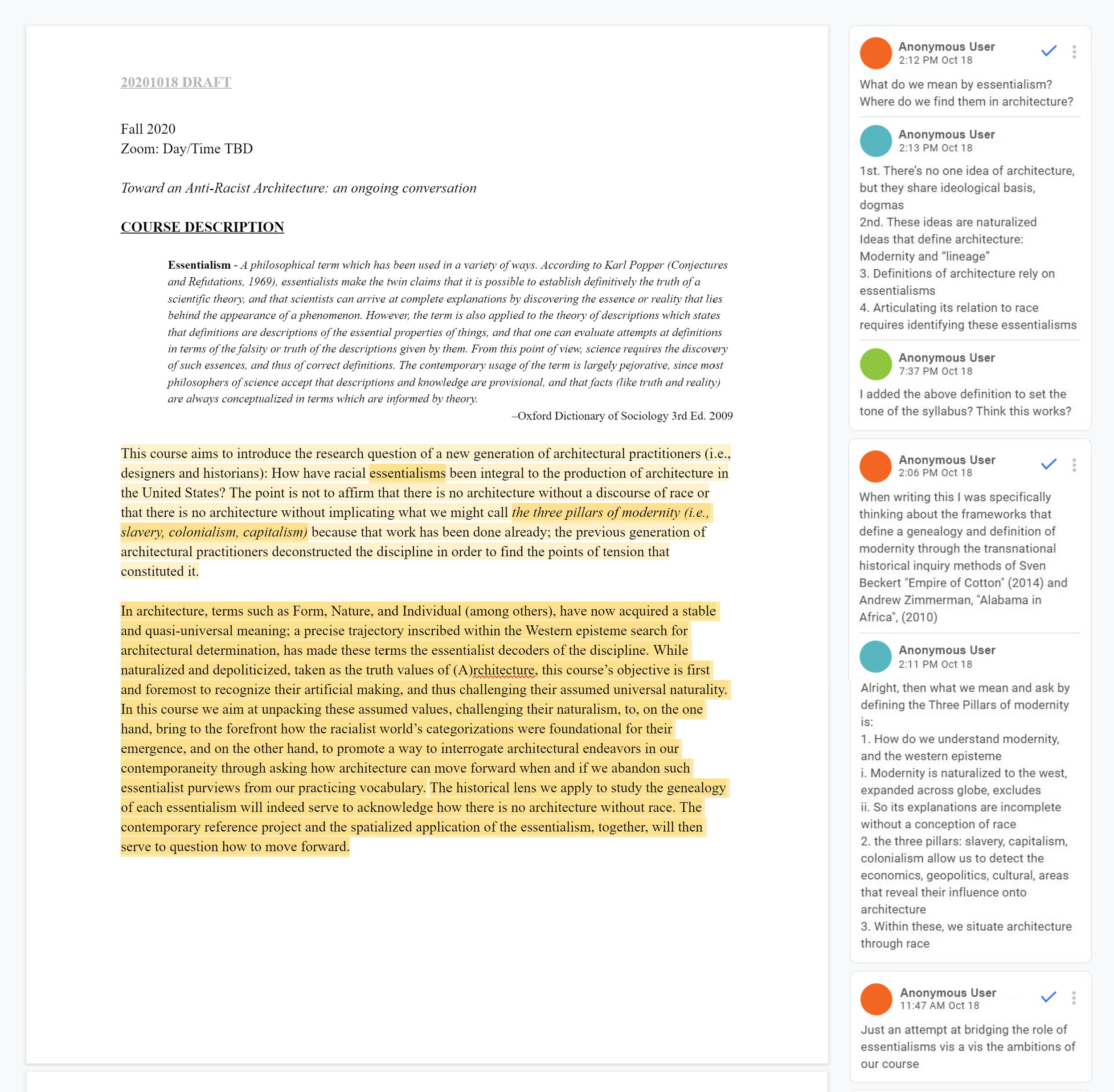
For the Spring 2020 term we, as part of a group PhD students and candidates, in a course entitled “Teaching Architecture History, Theory, and Criticism” at the Department of Architecture and Urban Design at UCLA, discussed the future of architectural pedagogy, shared strategies to create inclusive classrooms, and developed classroom exercises. Three months of conversations were to culminate in the final assignment of the course: the design of individual syllabi for a modern architecture survey. Two days before we were scheduled to meet to discuss our final products, Minneapolis police officers callously murdered 46 year-old George Floyd while arresting him for allegedly using a counterfeit bill. In the aftermath we felt that the design of the syllabi no longer resonated with our intellectual efforts, the historical stakes, or our emotional states and the scope of our final product seemed insignificant. We asked ourselves how a group of aspiring scholars of architecture, who in no way claim expertise in critical race theory, could possibly contribute to a collective need to reckon with America’s past and build a more just future. We recognized that regardless of our disciplinary knowledge and lack of authority, we nevertheless have a responsibility to not only expose the role of architecture in spatializing racial inequality but also to frame the question of our generation of architectural practitioners and scholars: how do we interrogate the architectural discipline and promote an anti-racist approach to the discourse?
During our final meeting of the course, we committed to spend the summer reading, learning, and exploring possible formats for activating this question. The collaborative syllabus that we present here is one possible format in which we can begin to integrate an anti-racist approach into an MArch curriculum. After a series of conversations with the Pidgin editorial team, we have decided to present it exactly as that: a record of an ongoing conversation that continues to transform in a live document. We designed the syllabus as a proposal for a new course pairing: each year the students of the PhD pedagogy course would design and lead a subsequent MArch seminar course, with the stated purpose of interrogating the essentialisms of the discipline. The upcoming panel is another possible format, one which can connect our efforts at UCLA to a broader audience. As part of the public programming for the Department of Architecture and Urban Design, we designed the panel as a way to bring together professionals and scholars in different fields of design practice, asking how they have transformed their practice into moments of self-criticality and an equitable future for design.* Regardless of the format, our project is not to produce answers but to ask questions. Reading groups, syllabi, and panels are just a small part of the process of dismantling structural racism in the university, our disciplines, and our communities. But, the questions that arise would nevertheless set an important foundation for aspiring practitioners and scholars undertaking this critical task.
*The UCLA Department of Architecture and Urban Design hosted a panel, entitled Toward an Anti-Racist Architecture, on January 23, 2021, from 9:00am to 12:00pm PST via Zoom.